
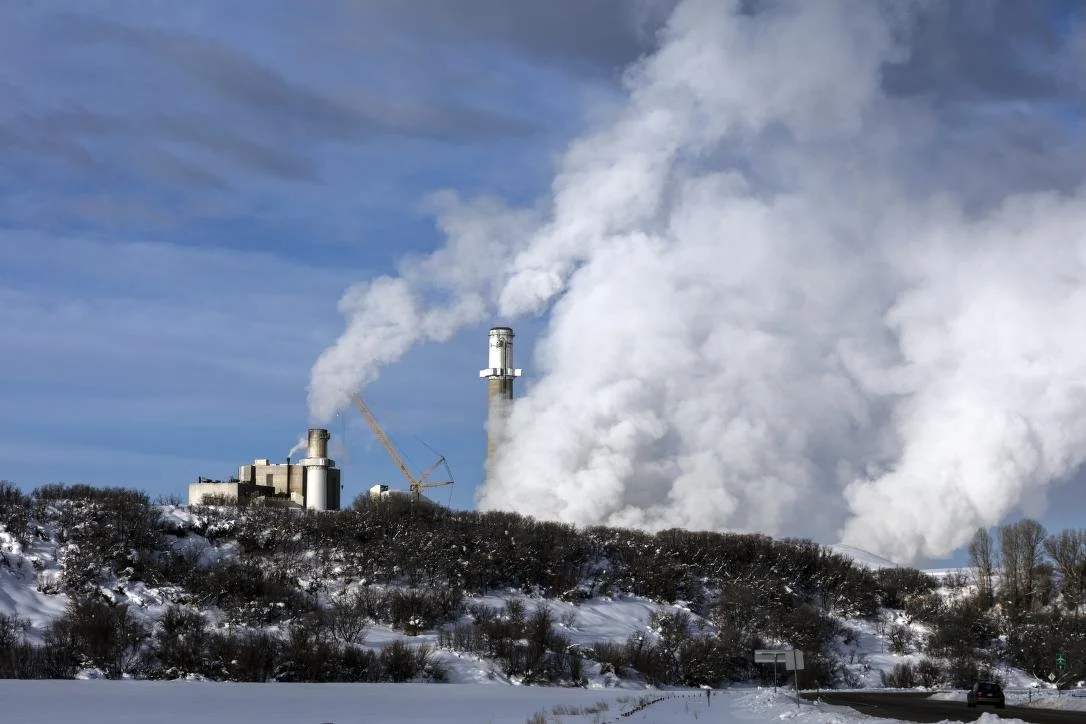
Coal-fired Hayden Power Plant, Colorado. Image credit: Carol M. Highsmith via Library of Congress
On September 14, 2026, the U.S. Environmental Protection Agency finalized a major rollback of federal greenhouse-gas standards for fossil fuel power plants. The final rule eliminates most of the 2024 Carbon Pollution Standards, including emission guidelines for existing fossil-fuel-fired steam generating units and carbon-capture-based requirements for certain coal and new natural-gas units. This change will result in lower air quality from increased pollution due to the continued or increased operation of fossil fuel plants.
The EPA argues that the previous standards depended too heavily on carbon capture and storage technologies that could not be deployed at the required scale and on the required timeline. The agency estimates that this partial repeal will reduce power-sector compliance costs and says the change will help preserve reliable and affordable electricity.
In the run up to the repeal, electric utilities and their representatives had also raised concerns about whether the previous requirements could be implemented without affecting reliability or forcing early power-plant retirements, making the case they needed this baseload generation to avoid outages. Those concerns are particularly relevant to rural electric cooperatives, many of which continue to rely substantially on coal and natural gas generation and NRECA, the association governing them, has publicly expressed their support for these pro-emitting regulations. Over 59% of the RECs generation is fossil fueled.
The Rural Power Coalition does not agree with this sentiment and has called on electric co-ops to transform their local grids through investments in local solar, storage, and energy efficiency projects to directly benefit their members.
But the economics of the electricity sector are changing independently of federal environmental regulations.
The Economics of New Generation Are Changing
Lazard, a financial advisory and asset management firm, with operations in North and South America, Europe, the Middle East, Asia, and Australia, conducts annual analyses on energy generation resources. Lazard's 2026 Levelized Cost of Energy analysis found that renewable resources remain the lowest-cost forms of new electricity generation on an unsubsidized basis, even after recent increases in construction costs. Utility-scale solar and onshore wind can provide energy at a much lower cost on both the high and low ends of the Lazard analysis when compared with new combined-cycle natural gas generation. However, this does not address capacity concerns. Renewables are currently facing low accreditation values for capacity with Regional Transmission Organizations (RTOs) and need to be built with battery storage systems to solve the capacity concerns that standalone clean energy generation projects are now facing. Lazard’s report also found that new gas generation faces equipment constraints, long development timelines, and some of its highest costs in roughly 15 years. There are also price concerns around long term natural gas price volatility due to the sharp increase in concurrent new builds across the United States.
That does not mean every existing fossil-fuel plant can immediately or economically be replaced by renewable generation. Reliability, transmission availability, storage, existing plant economics, and local system conditions all matter. The Lazard report emphasizes that growing electricity demand will require a diverse generation portfolio. But its findings complicate the idea that maintaining or expanding fossil fuel generation is necessarily the least-cost response to increasing electricity demand.
There is also evidence that some existing coal plants operate even when lower-cost electricity is available. The Rocky Mountain Institute (RMI) estimates that uneconomic coal operations produced approximately $23 billion in gross losses between 2015 and 2025. RMI is an independent, non-partisan 501(c)(3) non-profit organization founded in 1982 that transforms global energy systems through market-driven solutions. Its research found that regulated utilities, which can generally recover approved fuel costs from customers, accounted for a disproportionate share of those losses. These utilities recover fuel costs from customers similarly to how large rural electric cooperatives' generation and transmission cooperatives (“G&Ts”) recover costs from distribution co-op members.
The Public-Health Question
The debate also extends beyond carbon dioxide.
Coal generation produces conventional air pollutants associated with respiratory and cardiovascular health impacts. RMI's analysis of periods when coal plants operated despite cheaper alternatives estimates that resulting pollution produced 13–26 billion dollars in annual health costs. Using EPA's COBRA health-impact model, RMI estimated that emissions associated with uneconomic coal dispatch (or putting coal power on the grid at periods of time when it is not needed) between 2015 and 2023 contributed to thousands of emergency-room visits and premature deaths nationwide. These figures are modeled estimates rather than direct counts of individual cases.
Missouri provides a useful case study. A 2025 Stanford Law School and Stanford Center for Human and Planetary Health project examined the health implications of the New Madrid Coal Power Plant in southeastern Missouri and developed policy recommendations related to the plant and an eventual energy transition.
These considerations are especially relevant as electricity demand increases. Data centers, manufacturing facilities, electrification, and other large users of power such as data centers are creating pressure to add generation quickly. The policy question is therefore broader than whether the country needs more electricity. It requires thinking through how to meet that demand, what long-term operating costs are, who bears those costs, and how environmental and public-health consequences are accounted for.
Farms that are trying to grow can't count on this program.
The rules also limit eligible systems to a farm's past energy use. A farm that is adding a grain dryer, expanding a dairy herd, installing irrigation pumps, adding cold storage, or electrifying equipment will need more power next year than it used last year. Under the new rules, REAP cannot help farmers meet that demand.
This cap tells growing operations that they must plan their energy future based on their past. If a farm needs more power to expand, this rule does nothing for it. A program meant to strengthen rural economies should support farms that are growing, not cap them at yesterday's size.
What Happens Next?
The federal regulatory picture is not completely settled. EPA's September action finalized the repeal of most of the 2024 standards, but the agency is separately taking comments on its proposal to eliminate the remaining greenhouse-gas requirements for fossil-fuel power plants. The final partial repeal is scheduled to take effect November 16, 2026.
The repeal also does not prevent states, utility regulators, or utilities themselves from considering generation economics, air pollution, customer affordability, or clean-energy investments under other applicable authorities. State utility commissions will continue making decisions about resource planning, plant investments and retirements, new generation, and who pays for the infrastructure needed to serve rapidly growing electricity demand.
For anyone living in rural areas, these issues may seem like they are beyond our control, but they are of great consequence to our health and pocketbooks. The EPA and the nation’s biggest association of electric co-ops, NRECA, have come out saying that they do not mind a rollback of emissions standards, but not all of rural America is represented by this position.
For those who understand that a rollback of emissions standards will ultimately be to the detriment of rural communities, it is important to be in communication with your local electric utility leadership about this issue, and to talk to your neighbors about this.
Make your voice heard, and ensure that those who maintain your local energy grid understand your position on this issue.
Get Involved
Fifteen state attorneys general (AGs) are already opposed to this federal action from the following states:
Arizona
California
Connecticut
Hawaii
Illinois
Maine
Maryland
Massachusetts
Minnesota
New Mexico
North Carolina
Oregon
Vermont
Washington
Wisconsin
Newly elected AGs are setting priorities for their time in office. Now is the time to ask them to stand up for affordable electricity, clean air, and rural communities.
If you are in Colorado, Georgia, Iowa, Kansas, Michigan, Nevada, Ohio, Rhode Island, or Texas, please contact your Attorney General elect to get them to oppose the EPA’s rollback.
Ask them to review opportunities to join or support the legal challenge to EPA’s rollback or continue their state’s involvement and meet with rural residents about keeping electricity costs low and pushing back against power plant pollution.