
Working towards energy affordability in rural America
Originally published on Shareable.
If you live in the United States, there is a one-in-eight chance that you own your electric utility. That is to say that there’s a one-in-eight chance that your electric utility has a similar structure to a credit union or food cooperative. And if you are one of the many millions of residents who pay a gas and electric bill to a co-op utility, then you have a lot of potential power that can be leveraged to save yourself—and others in your community—money through proven affordability programs that shift local infrastructure toward efficient, modernized, renewable energy.
But it’s not just a random roll of an eight-sided die that determines whether or not you belong to a cooperative utility. If you live in a rural area, it’s quite likely you are a member-owner of an electric co-op. If you live in a bigger city, it’s almost guaranteed that you aren’t.
About 13% of customers—or 42 million residents around the United States—are member-owners of rural electric cooperatives. Most electric co-ops were created to address the reality that the country was in an economic crisis and people were struggling.
The problems of yesterday, today
In the mid-1930s, the Great Depression was having adverse effects across many areas of life around the United States, and the damage was especially pronounced in rural areas. Rural America was getting left behind as private utilities focused on their own profitability rather than the well-being of broader society. Because of this, the vast majority of the rural US was left without power, while urban areas were getting electrified.
The next time you travel between urban and rural areas, pay attention to how far power lines must span in order to get to one additional home. In urban areas, this distance may just be a few yards. In rural areas, this distance could be miles. This means that urban areas require less infrastructure maintenance per additional billable meter. For for-profit companies, like investor owned utilities (IOUs), this means much more money with less hassle—and this is why a profit-first model for electrification sidelined rural residents, and why cooperatives offered and continue to provide a mechanism by which localized decisionmaking can meet local needs.
Today, we face similar, widespread crises of unaffordability and the constant prioritization of private profits over public well-being. Rural residents can see that their needs and concerns are not being addressed by a leadership that is primarily answerable to corporate interests.
While most of the United States is now electrified, energy costs are skyrocketing. The rapid buildout of AI data centers puts private profit first, ahead of the needs of the communities that are compelled to host them. These data centers are driving up energy costs, which have increased 7.4% on average for residential units. Even desirable energy infrastructure like solar arrays are too often built out without community input and responsiveness to community needs.
For many, it is becoming increasingly unaffordable to keep homes at safe and comfortable temperatures. In the realm of energy and other essentials like food and healthcare, state and federal affordability programs and subsidies are being slashed. Meanwhile, the rich never stopped seeing their profits increase, with federal tax breaks functioning as huge subsidies for the ultra-wealthy, or those who earn more than $1 million each year.
If we look to our federal leadership, we often find that what we see is not a concern for working people and the issues we face, but an agenda that prioritizes the needs and whims of those who already hold power and have ample wealth.
Local power on rural energy issues
Although making progress on energy transition can often seem impossible, co-op utilities have the power to make real changes. This means that a significant impact can be made by rural residents, with just a little bit of consistent organizing pressure.
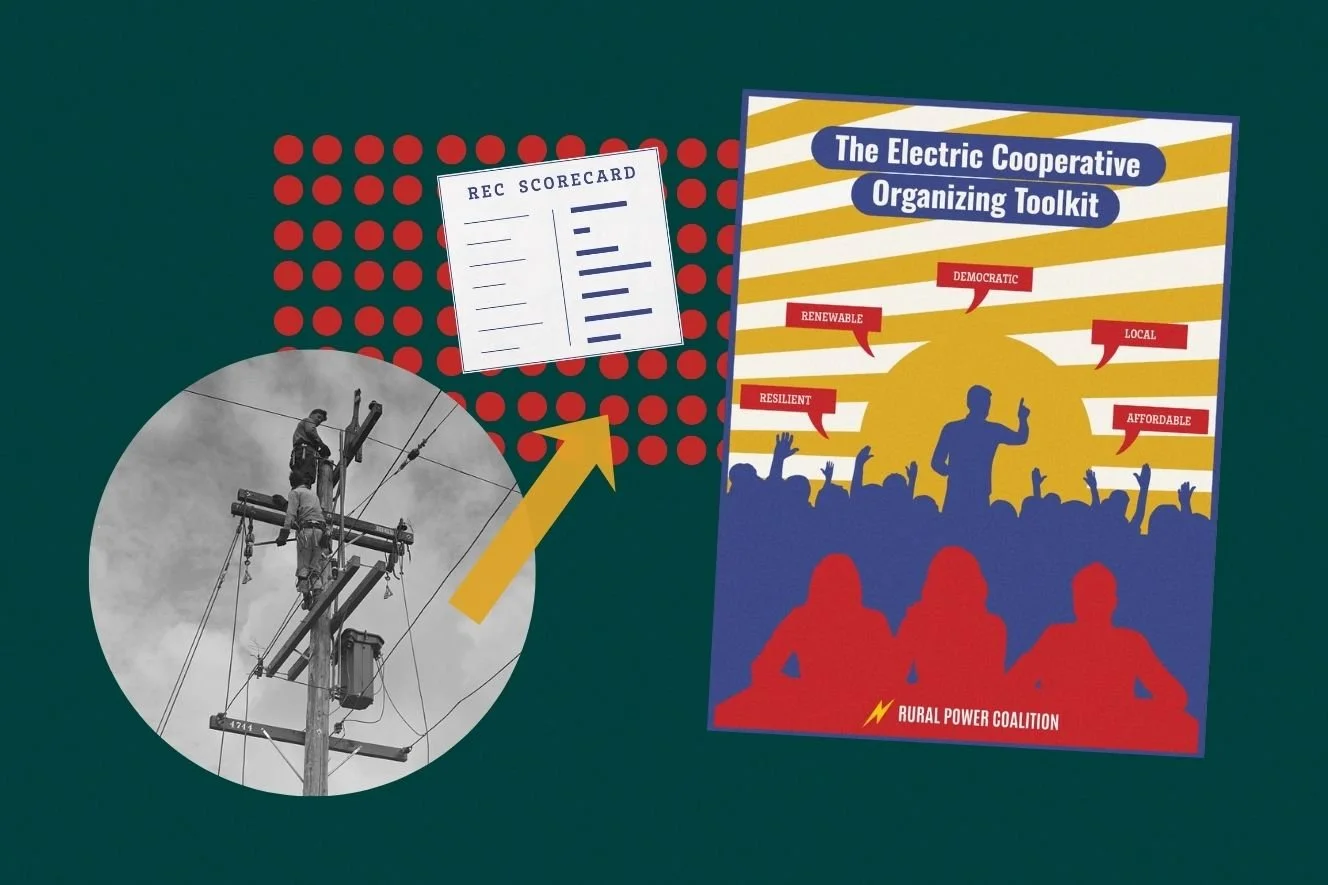
To those ends, the Rural Power Coalition—to which Shareable is a working partner—has just released a comprehensive organizing toolkit that helps people understand how rural electric cooperatives work, how to engage with them, and projects and programs that can be implemented at the local utility level.
Studies have found that a majority of electric co-op member-owners do not know that they are member-owners. Contained in the toolkit is a short section on how to determine if you are, in fact, a member-owner of an electric co-op.
Circling back to some of the issues mentioned above, the toolkit gets into how to engage with co-op staff and leadership to press for improvements at your utility. It explores communications and pressure tactics designed to get leadership to be more responsive to community needs. It outlines the concept of community benefits plans, which enable locals to maximize benefits from a proposed project—like a solar array, wind farm, or even a data center—in their region. Community benefits can include things like funding for local schools, community centers, or beloved local programs that are facing budgetary shortfalls.
To access this free Rural Electric Organizing Toolkit, visit:
https://www.ruralpower.us/toolkit
How to turn the Electric Cooperative Organizing Toolkit into real, impactful change
The toolkit could be considered a short textbook or reference document. It will ground readers in thinking about how to start engaging in efforts that have meaningful, positive outcomes in a neighborhood or utility service area, while providing a basic foundation and some proven ideas that can be built on that foundation.
As a companion to the Electric Cooperative Organizing Toolkit, the Rural Power Coalition will offer a free training in early 2026.
Participation in the training will provide an opportunity to learn from folks who work on energy issues, while engaging with other organizers (or organizers-to-be) who want to get more engaged in their local electric co-op.
For those who want to engage more deeply, the training will also offer simple assignments that encourage attendees to be in communication with co-op leadership, read and understand co-op by-laws, or think through strategies around applying pressure to leadership—and all of this can be discussed with other attendees and presenters.
The idea here is to have community members, not specialists, to drive the efforts to work toward energy affordability, reliability, and sustainability in rural areas.
Free 2026 member-owner training series
The member-owner training will begin on Thursday, January 22, and will run for four consecutive Thursdays. Participants are encouraged to attend all four sessions, since they will build on each other, but attending all of them is not required.
Sessions will be one hour long, with some limited interactivity, and will begin at 7PM Eastern/ 4PM Pacific.
2026 Member-Owner Training Series
Thursday, Jan 22: Organizing Around Energy Affordability & Resiliency
Thursday, Jan 29: Organizing Electric Co-op Members
Thursday, Feb 5: Mobilizing People & Applying Popular Pressure
Thursday, Feb 12: Building Coalitional Power
There is a short registration form for the member-owner training is available here:
https://forms.gle/aEaodN5iTnpYGTQq5
This training is designed for member-owners of rural electric co-ops, but all are welcome, and even if you pay bills to an investor-owned utility or a municipal utility, you'll come away from this training with useful knowledge.
And, in addition to signing yourself up, please share this opportunity with any community members who may be interested in getting engaged in some local, energy-related organizing with you!